



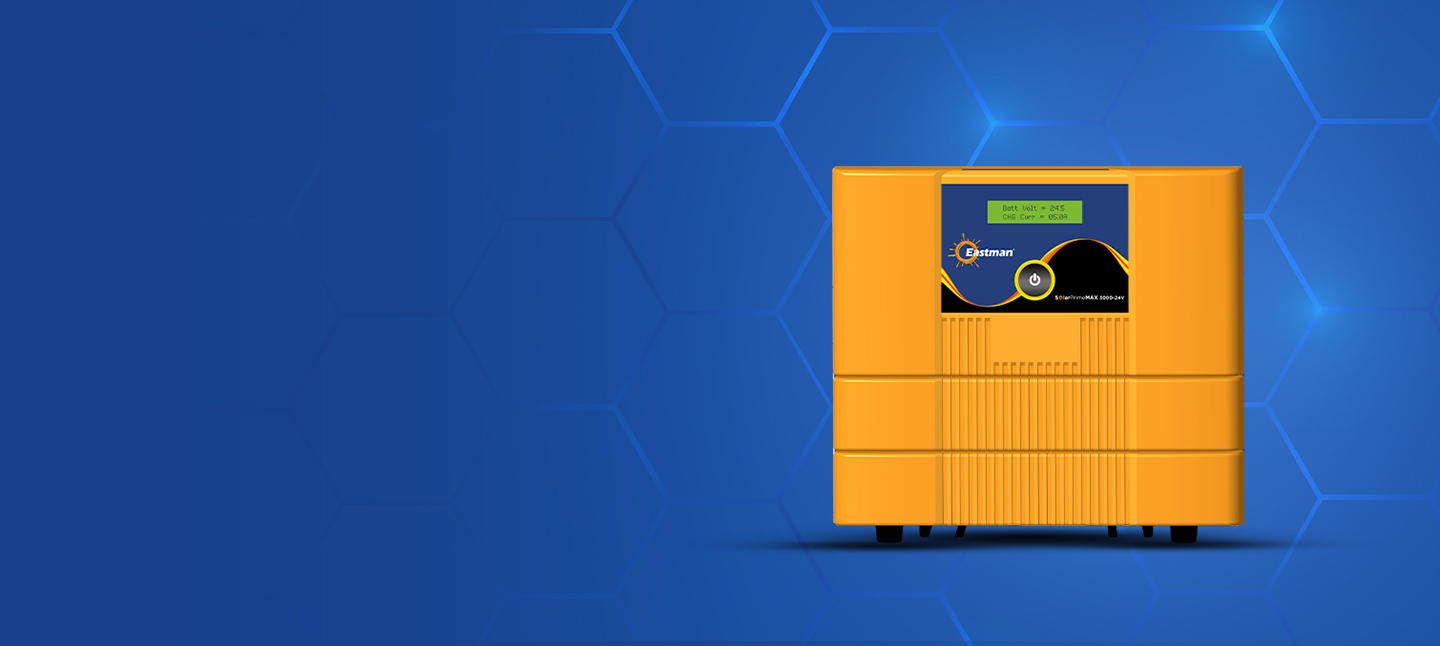


Solar Off-Grid Inverter Solar Prime Max 12V/24V/48V+
 1000VA - 10000VA
Range
 MPPT
MPPT
Technology
 3
3
Years Warranty*
*T&C Apply
What Makes It Different?

Reliability Life Uninterrupted

User-Friendly LCM Display — Minimal Selectable Switches
One screen shows battery, solar, load and faults Status — No Complicated settings, simple buttons & zero confusion.

Peak Load Peak Output (PLPO)
Your fridge, motor, and pump start up smoothly every time — no tripping, no restarting, no worry.

In-a-wink Changeover — Static Changeover Technology (Optional)
Switchover happens so fast that your lights, fans and Wi-Fi never flicker — not even for a split second.

Total Cost of Ownership A Lifetime of Value

Maximum Solar Power Input — Up to 1.3X Rated Capacity
Takes in 30% more power from solar panels — It charges the battery faster and provides backup when you need it most.

Maximum Power Point Tracker (MPPT - Buck based) Solar Charger Topology with Perturb & Observe Topology
Solar panels always produce at their absolute best — so every bit of free sunlight turns into electricity, nothing is ever wasted.

Fuzzy Logic Based Technology — Intelligent Adaptive Charging
Charges based on the battery’s actual condition, not a fixed schedule — extends battery life.
Benefits Built For You

Energy Independence with Complete Power Control

Zero Electricity Bills with Maximum Savings

Uninterrupted Power Supply 24/7

Eco-Friendly Living with Clean Renewable Energy

Low Maintenance with High Long-Term Returns
A Perfect Solar Fit For

Rural Households

Small Shops

Coaching Centers

Flour Mills
Cold Storage

Dairy Farms
Downloads 
FAQs
What is a Solar Off-Grid Inverter?
A Solar Off-Grid Inverter converts DC power stored in batteries (charged by solar panels) into AC power for running home appliances — completely independent of the electricity grid.
How does a Solar Off-Grid Inverter work?
Solar panels charge batteries during the day; the inverter converts stored DC energy into usable AC electricity for lights, fans, and appliances — day and night.
What is the difference between Off-Grid and On-Grid Solar Inverters?
Off-Grid inverters work independently with battery storage; On-Grid inverters feed power back to the utility grid and do not work during power cuts.
How much does a Solar Off-Grid Inverter cost in India?
Prices range from ₹5,000 to ₹80,000+ depending on capacity (1kVA to 10kVA), brand, and battery compatibility.
Can a Solar Off-Grid Inverter eliminate my electricity bill?
Yes — a correctly sized off-grid system can bring your electricity bill to zero by meeting 100% of your energy needs through solar power.
What is the payback period for a Solar Off-Grid System?
Typically 3 to 5 years, after which the system generates free electricity for the remaining 20+ year lifespan.
What size Solar Off-Grid Inverter do I need for my home?
Calculate your total daily load (watts × hours); a standard 2–3 BHK home typically requires a 3kVA to 5kVA off-grid inverter.
Which battery is best for a Solar Off-Grid Inverter?
Lithium-Ion (LiFePO4) batteries offer the longest life and best performance; Tubular Lead-Acid batteries are a cost- effective alternative for budget setups.
Can a Solar Off-Grid Inverter run an air conditioner?
Yes — with adequate capacity (minimum 3kVA–5kVA) and sufficient battery bank, an off-grid inverter can comfortably power a 1–1.5 ton AC unit.
How many solar panels are needed for an Off-Grid Inverter?
A 1kW off-grid system typically requires 3 to 4 solar panels of 330W–375W each, depending on daily sunlight hours in your location.
Is Solar Off-Grid Inverter suitable for rural areas?
Absolutely — off-grid solar is the ideal solution for villages, farms, and remote locations where grid power is unreliable or unavailable.
Can I use a Solar Off-Grid Inverter during monsoon or cloudy days?
Yes — batteries store sufficient energy to power your home through 1 to 3 cloudy days, depending on battery capacity and load.
What appliances can a Solar Off-Grid Inverter run?
Lights, fans, TVs, refrigerators, water pumps, mobile chargers, computers, and small machinery — based on the system's kVA capacity.