




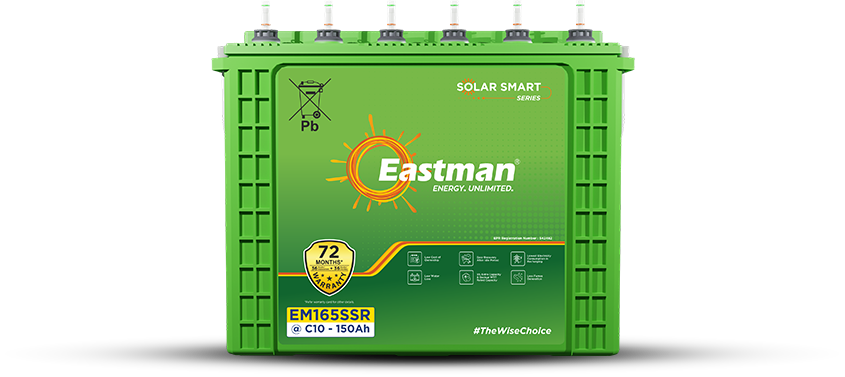

Conventional Tubular Battery
(Solar Smart Series)
 150Ah / 200Ah
Range
 36+36
36+36
Months Warranty*
*T&C Apply
What Makes It Different?

Reliability Life Uninterrupted

Easy Recovery After Idle Period
Comes back to full capacity even after months unused — always ready to power your appliances.

Less Fume Generation
Almost no fumes during charging — safe to install near living spaces, safe for children.

Total Cost of Ownership A Lifetime of Value

Lowest Electricity Consumption in Recharging
Consumes less electricity while charging battery — saving electricity and your money every day.

Low Water Loss
Almost no water top-up needed — less maintenance, less cost and longer life.

5% Extra Capacity vs. Rated
You get 5% more backup than the label promises — More Power at no extra cost.
Benefits Built For You

Optimised for Solar Charging Cycles for Better Everyday Performance

Get 5% More Power Than What the Label Promises

Almost Zero Maintenance with Low Water Loss and Rare Top-Ups

Safe to Install Indoors with Less Fume Generation During Charging

Reliable Backup Through Every Power Cut with Deep Discharge at 80% DoD
A Perfect Solar Fit For

Urban
Homes
Small
Shops
Small
Offices
Solar Inverter
Systems
Residential
Backup
Frequent Load
Shedding Areas
Downloads 
FAQs
What does 80% depth of discharge (DoD) mean?
It means you can safely use 80% of the battery's rated capacity in every charge cycle — protecting the plates and extending battery life. Most cheaper batteries are rated at 50–60% DoD, meaning they actually deliver less usable backup per Ah of rated capacity.
What is the 5% Extra Capacity vs Rated?
Eastman tubular batteries are built with slightly more active material than the rated capacity — meaning you get more backup than the label states. A 200Ah battery typically delivers 210Ah of actual capacity. More power at no extra cost.
Why do tubular batteries recover well after long idle periods?
The tubular plate design prevents excessive sulphation during idle storage — the primary cause of capacity loss in lead-acid batteries. Eastman tubular batteries come back to near full capacity even after several months without use.
How often do I need to top up water?
Very infrequently — the low water loss design means most users top up once in 3–4 months under normal use. Reduced topping frequency means less maintenance effort and cost over the battery's lifetime.
Which PCU models are these batteries compatible with?
All Eastman tubular batteries are fully compatible with Solar Smart, Solar Smart Max, Solar Prime, and Solar Prime Max PCUs. They are also compatible with most standard Indian home inverters. Your dealer will confirm compatibility with your specific setup.
How do I know when to replace my tubular battery?
Signs include significantly reduced backup time, difficulty holding charge despite full charging, or swollen casing. Most Eastman tubular batteries last 4–7 years with proper maintenance. Annual water checks and keeping terminals clean extends life.
Can I connect multiple tubular batteries for more backup?
Yes — for higher voltage systems (24V or 48V), batteries are connected in series. For more Ah capacity, batteries of the same model can be connected in parallel. Your dealer will design the correct configuration.
What warranty and support do these batteries carry?
Regular Series: 10-year total warranty (60 months replacement + 60 months pro-rata). Solar Smart Series: 6-year total warranty (36+36 months). Eastman Assure manages all claims — 1800-419-8610 | WhatsApp +91 78728 78728 | eastmanassure.com.
Is there a way to check if my battery is performing well?
You can periodically check the electrolyte level and colour (clear/light yellow is healthy, brown indicates contamination). Measure backup time against expected duration. For a full health check, your Eastman service engineer will test specific gravity and load performance during a service visit.